
Operational improvement
does not end at launch.
The Laminar Operating Partnership gives growing businesses structured access to ongoing systems analysis, implementation, documentation, and operational improvement. Each engagement begins with a documented assessment and a prioritised roadmap, then moves into a disciplined monthly operating cycle.
A system can be launched in weeks.
Operational maturity takes longer.
Most businesses that have deployed tools, software, and processes still run into the same friction — not because the systems are wrong, but because they are disconnected, inconsistently used, poorly documented, or no longer aligned with how the company actually operates.
Leads falling between systems. The CRM has contacts that were never followed up on because the handoff was manual and someone moved on.
CRM pipelines no longer reflecting reality. Deals sit in stages they left months ago. Reporting is meaningless because nobody maintains the data.
Repeated manual work. The same tasks are done by hand every week because no one has built the system to handle them automatically.
Unclear accountability. Work moves through the business but nobody can say with certainty who owns what, or where things currently stand.
Metrics that don’t guide decisions. The dashboard exists. Nobody looks at it before making a call because nobody trusts the numbers.
Undocumented workflows. The process exists in someone’s head. When that person is out, everything slows down or gets done differently.
Automations that fail silently. A workflow that ran for months stopped working. Nobody noticed until a customer mentioned they never received a reply.
Teams working around systems. The tools are there but people use spreadsheets and email because the systems are too slow or too confusing to use consistently.
A one-time implementation can establish the foundation. The Operating Partnership keeps improving what happens next.
How the engagement works.
Three structured stages. Assessment before action. Defined scope before execution. Documented output every month.
Initial Operational Assessment
Before any recurring work begins, Laminar conducts a structured review of the business’s current systems, workflows, data quality, reporting, and operational risks. This is not a discovery call — it is a documented operational audit that surfaces where friction exists, where systems are misaligned, and where the highest-leverage improvements are. Businesses that need to diagnose an uncertain problem before committing to any path should start with a FluidDynamics™ assessment first.
Documented current-state assessment and prioritised 12-month improvement roadmap. The prerequisite for the Operating Partnership.
Monthly Operating Cycle
Each month is scoped to a limited number of approved priorities from the roadmap — not a rolling pile of undefined requests. Laminar uses defined monthly capacity to execute approved improvement work: not to advise on it from the outside, but to implement it.
- CRM configuration, governance, and data quality
- Workflow design and process documentation
- KPI frameworks and reporting systems
- Automation implementation and maintenance
- Practical AI implementation where there is a validated operational case
- Platform and vendor coordination
Monthly and Quarterly Review
Each month closes with documented outputs, updated priorities, and a clear record of what was completed, blocked, deferred, or moved into separate scope. Quarterly reviews step back to assess overall progress against the roadmap and adjust direction where needed.
Written record of priorities and decisions · Updated roadmap and work queue · Capacity report · Documentation of completed and changed processes.
A real operating cadence, not another advisory call.
- Structured operating review
- Written record of priorities, decisions, and next actions
- Updated roadmap and work queue
- Implementation work against approved priorities
- Monthly capacity report
- KPI dashboard review where applicable
- Documentation of new or revised processes
Covers meetings, analysis, implementation, coordination, documentation, reporting, and operational triage. Additional capacity may be approved separately where required.
The engagement includes quarterly systems health reviews and ongoing roadmap management. Priority response during business hours. Every cycle is tracked through the Laminar Pipeline — not a shared spreadsheet or a call with no record.
Where the capacity goes.
These are the areas covered by the monthly operating cycle. Not all areas are active every month — work is approved and prioritised from the roadmap.
Configuration, governance, reporting, workflow maintenance, and data-quality improvements. Keeping the CRM an accurate reflection of the business, not a historical archive nobody trusts.
Map, improve, document, and maintain the processes that move work through the business. Build systems the team can follow consistently — not just understand in theory.
Define meaningful measures, establish baselines, and keep reporting aligned with actual decisions. Measures that get looked at and acted on — not dashboards for dashboards’ sake.
Identify and implement automation or AI only where there is a validated operational case. If a manual step should be automatic, make it automatic. No AI hype — only what demonstrably improves operations.
Create SOPs, workflow diagrams, decision records, and process references that reduce dependency on memory. When a process is documented, it can be delegated, improved, and followed consistently.
Review systems, integrations, subscriptions, and ownership. Determine whether platforms are supporting or obstructing operations. Coordinate with vendors where needed to close gaps.
The engagement is managed through the Laminar Pipeline.
Every Operating Partnership is delivered through a structured playbook that tracks qualification, assessment, onboarding, monthly priorities, implementation work, capacity, decisions, blockers, deliverables, quarterly audits, and eventual renewal or graduation.
Each month has its own operating cycle — a clear record of what was approved, what work was performed, where capacity was used, what changed in the systems, and what the client needs to act on next.
- What was approved for the month
- What work was performed and where capacity was used
- What was completed and what the client needs to act on next
- What was blocked and what moved forward
- What changed in the systems as a result
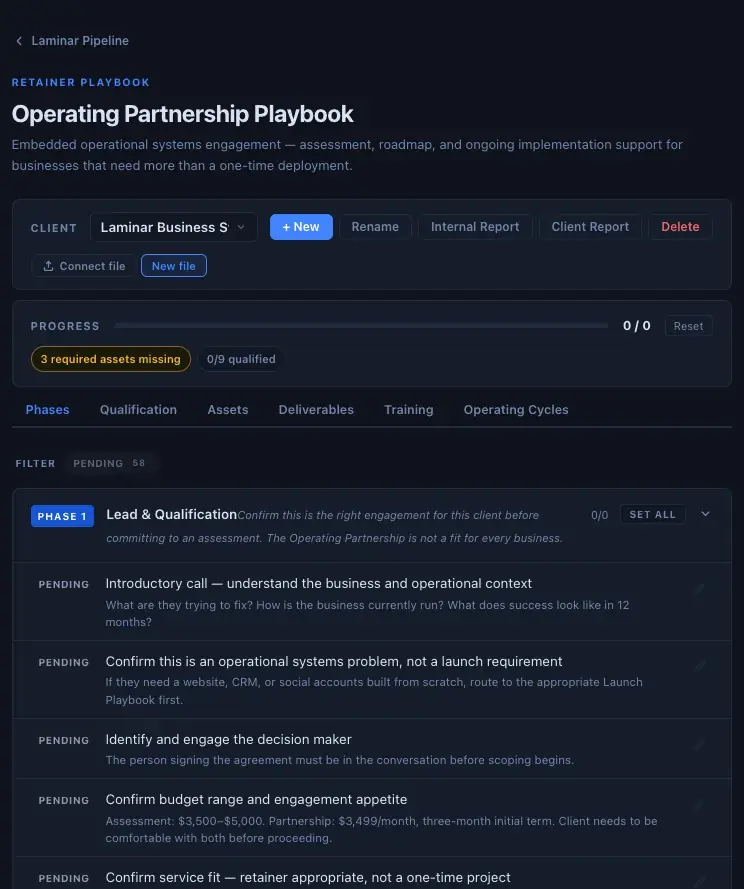
The Laminar Pipeline — Operating Partnership Playbook. Every engagement runs through the same structured system.
Built for businesses with real operational complexity.
Good fit
- Growing service businesses adding staff, locations, or service lines
- Companies with several disconnected platforms that need to work together
- Owners who lack reliable visibility into leads, work, delivery, or performance
- Teams whose processes depend heavily on individual memory
- Businesses that have already launched but need sustained operational discipline
- Companies with a credible backlog of improvement work extending beyond one project
Businesses that need a website, a basic CRM setup, occasional technical support, or a single isolated project are better served through a Launch Playbook or a separately scoped engagement — not a monthly partnership.
“A Launch Playbook establishes the operational foundation. The Operating Partnership keeps improving the business built on top of it.”
Two components. Defined scope.
The assessment precedes the partnership. Both are priced separately so there are no surprises.
This is a deeper, scoping-grade assessment than the FluidDynamics™ diagnostic. Where FluidDynamics™ identifies an uncertain problem and recommends a path forward, the Initial Operational Assessment defines the full operating roadmap, establishes KPI baselines, and produces the 12-month improvement plan the partnership runs against.
Includes- Full systems and workflow review
- Stakeholder interviews
- Gap and operational risk analysis
- KPI baseline
- Prioritised 12-month improvement roadmap
- Recommended operating cadence
- Up to 20 hours of Laminar capacity
- Defined monthly deliverables
- Priority response during business hours
- Quarterly systems health reviews
- Ongoing roadmap management
Clients proceeding to the partnership within 30 days of the assessment receive a $1,000 credit against the first month.
The goal is capability, not permanent dependency.
Laminar does not create unnecessary dependence. Every month of the engagement should leave the business operationally better off than the month before.
- Documented systems the team can follow and reference
- Improved operational visibility without buried dashboards
- Repeatable workflows that don’t depend on who’s available
- Clearer ownership of processes and platforms
- Useful reporting that guides real decisions
- Reduced manual friction in day-to-day operations
- A team capable of operating the systems independently
A successful engagement may renew, change scope, or graduate. A healthy exit is an intended outcome, not a failed retainer.
Renewal makes sense when there is a sustained backlog of high-value operational work. Graduation makes sense when the business has the systems, documentation, and internal capability to continue improving on its own.
Both are defined outcomes. Neither is a surprise.
Your business does not need more disconnected advice.
It needs a clear operating roadmap, disciplined execution, and a reliable record of what changed.
The introductory call determines whether the Operating Partnership is appropriate or whether a Launch Playbook, a standalone project, or a FluidDynamics™ diagnostic would be the better fit.
Need to establish the foundation first? Start with the Business Launch Playbook or Digital Presence Launch Playbook before moving into ongoing operational improvement.